How Male Octopuses Use Chemical Signals to Reproduce in Darkness
Octopus mating has long raised questions among marine biologists, mainly because the process happens with almost no visual coordination. The male octopus keeps a clear distance from the female and relies on a highly specialized arm to complete reproduction.
Recent research published in the journal Science sheds light on how this unique system works, revealing that the mating arm carries a sensory ability far more advanced than previously understood.
Instead of relying on vision, the male uses a dedicated arm called the hectocotylus. This arm delivers a packet of sperm directly inside the female’s reproductive system, raising a key question: how does it locate the correct internal opening with such precision in dark, unpredictable conditions?
The Hectocotylus
During mating, the male octopus extends the hectocotylus into the female’s mantle, a cavity located behind the eyes that contains major organs, including reproductive structures. From there, the arm carefully searches until it reaches the oviduct, where fertilization can occur.
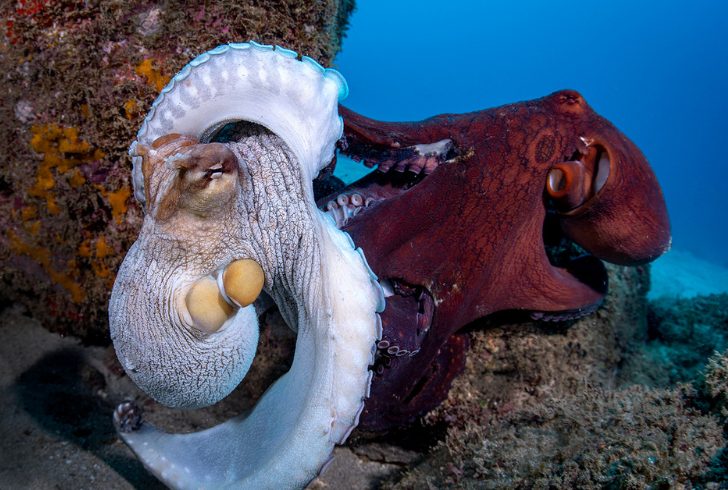
Instagram | sundivers_mauritius | The male octopus uses its specialized hectocotylus arm to deliver sperm directly into the female’s mantle cavity.
What makes this process unusual is the arm’s dual function. In most octopuses, seven arms handle exploration and feeding. These arms carry chemotactile receptors that allow the animal to “taste” its surroundings, helping it identify food and detect harmful microbes in the water.
However, the hectocotylus behaves differently. Normally tucked close to the body when not in use, it activates only during mating. Until recently, scientists did not fully understand how it guided such precise reproductive action.
Chemical Signals That Guide Reproduction
The study revealed that the female octopus plays a direct role in guiding the male’s mating arm. The oviduct produces enzymes that generate progesterone, a key sex hormone. The hectocotylus contains a dense concentration of chemotactile receptors that can detect this hormone.
This means the male does not rely on sight. Instead, it senses chemical signals released inside the female’s body. These receptors act like molecular sensors, guiding the arm directly to the correct reproductive site.
Researchers also tested detached hectocotylus tissue and observed movement responses when exposed to progesterone. Interestingly, the same reaction did not occur with similar hormones, confirming the specificity of detection.
Analysis of three male octopuses showed that the mating arm contained up to three times more chemotactile receptors and neurons compared to a standard arm. This structural difference explains the precision involved in locating the oviduct during mating.
Behavior Studies in Controlled Conditions
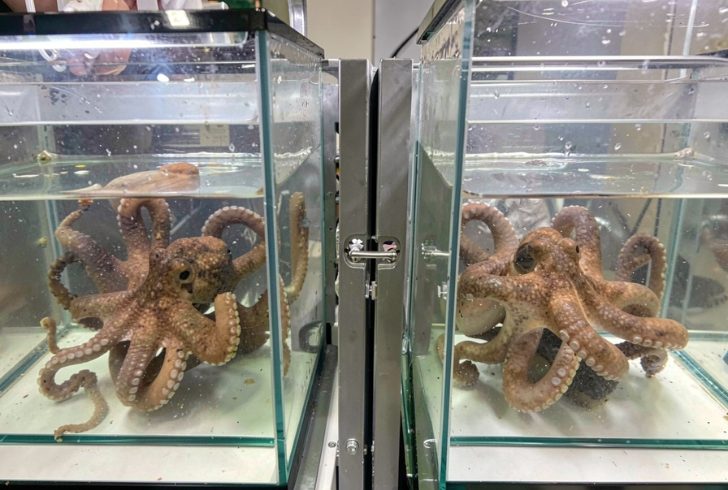
Freepik AI | By using dividers with small holes, researchers safely observed male and female octopuses without the risk of violence.
Laboratory observations provided additional clarity. Male and female octopuses were placed in tanks separated by a divider, since direct contact often leads to aggression and even fatal encounters. The divider included small openings that allowed partial interaction between the two.
Once the animals became familiar with the setup, the male often extended the hectocotylus through the openings and inserted it into the female’s mantle. This behavior repeated across multiple pairs under identical conditions.
Even in complete darkness, the same mating behavior continued. This confirmed that visual cues are not required for reproduction, reinforcing the role of chemical sensing as the main guide.
Scientific Insight From Expert Observation
Professor Nicholas Bellono, senior author of the study from Harvard University, described the system as highly efficient for the octopus lifestyle.
As he noted, “It makes sense that the arm is both the sensor and the mating organ because in these chance encounters, the arm has to be able to both localise the female, localise the oviduct and very quickly initiate the mating or move on,” as reported by The Guardian.
This explanation aligns with the octopus’s largely solitary behavior. Encounters between individuals are rare, so reproduction must happen quickly and accurately when contact does occur.
The hectocotylus reveals how deeply specialized octopus biology can be. Acting as both a sensing tool and a reproductive organ, it detects progesterone signals inside the female and guides sperm delivery with precision.
Studies published in Science, including tests on three individuals and controlled tank experiments, show that this process works even in total darkness and under conditions of separation. This discovery adds a new layer to understanding how octopuses manage reproduction in an environment where timing and chemical communication matter more than sight.