Scientists Discover Unexpected Wind Pattern on Giant Alien Planets
Astronomers studying some of the hottest planets ever discovered have found something strange happening high above their clouds. These giant alien worlds, known as hot Jupiters, were expected to produce the fastest winds in the galaxy because of their extreme heat. Instead, new observations revealed that many of them have surprisingly slow atmospheric currents.
The discovery has raised new questions about how these distant planets behave and may offer one of the strongest signs yet of magnetic activity outside the Solar System.
A Strange Discovery on Hot Jupiters
Hot Jupiters are massive gas planets that orbit dangerously close to their stars. Some complete a full orbit in less than a single Earth day. Because of this close distance, temperatures on these worlds can climb into several thousand degrees.
Scientists expected these extreme conditions to generate violent atmospheric circulation. Strong heat differences between the permanent day side and permanent night side should push winds to incredible speeds.
A new study led by astronomer Julia Seidel from Côte d’Azur Observatory in France tells a different story.
After analyzing seven hot Jupiters, researchers found wind speeds that were far weaker than predicted. While the winds remain far more intense than anything seen in the Solar System, they still fall short of scientific expectations for planets this hot.
“The hotter a planet is, the stronger its atmospheric currents should be,” the researchers explained while discussing the puzzling trend.
Why Hot Jupiters Stand Out
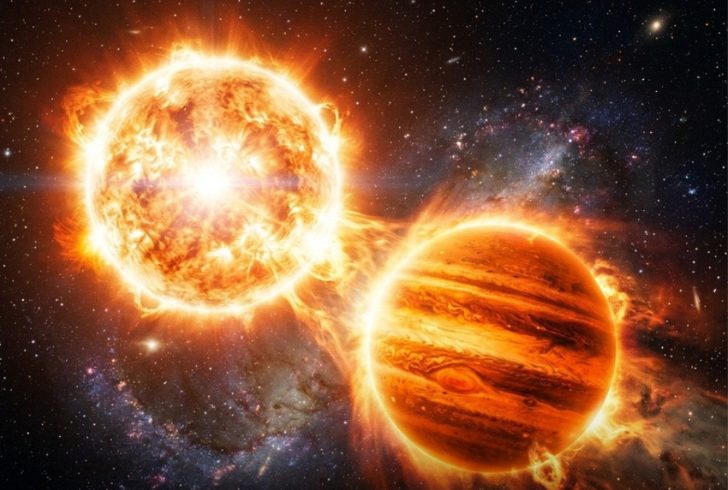
Instagram | spaceman.in | Hot Jupiters are highly unusual exoplanets with harsh, unstable environments caused by their ultra-close stellar orbits.
Hot Jupiters already rank among the most unusual exoplanets in the Milky Way. Their close orbit around host stars creates harsh and unstable environments.
Most of these planets are tidally locked. One side constantly faces the star in endless daylight, while the opposite side remains trapped in darkness. This permanent contrast creates dramatic temperature differences across the planet.
That setup should produce chaotic weather systems and powerful jet streams racing through the atmosphere.
Scientists also know these planets receive intense stellar radiation. Some are so hot that parts of their atmospheres slowly evaporate into space.
Because of these conditions, astronomers expected atmospheric winds to increase as planetary temperatures rose. The latest findings showed the exact opposite.
Wind Speeds That Defy Expectations
To investigate the mystery, researchers used two advanced instruments: the MAROON-X spectrograph on the Gemini North telescope and the ESPRESSO instrument on the European Southern Observatory’s Very Large Telescope.
The team tracked vaporized iron moving through the atmospheres of seven hot Jupiters. By studying how the iron shifted in light spectra, astronomers calculated wind speeds across each planet.
The recorded winds ranged between 2 and 7 kilometers per second, or roughly 1.2 to 4.3 miles per second.
For comparison, Jupiter — the windiest planet in the Solar System — reaches speeds of about 0.4 kilometers per second.
Even so, the trend shocked scientists.
The hottest planets in the study consistently showed slower winds than cooler hot Jupiters.
“This is totally counterintuitive because, all things being equal, hot planets have more energy to accelerate the winds,” said astronomer Vivien Parmentier of Côte d’Azur Observatory. “Something must happen that slows down the wind speeds for hotter objects.”
Magnetic Fields May Be Slowing the Winds
The leading explanation points toward magnetic fields.
Researchers believe electrically charged gases in these overheated atmospheres may interact with planetary magnetic fields. That interaction could create a braking effect strong enough to slow atmospheric circulation.
Scientists cannot directly measure magnetic fields on exoplanets yet. However, atmospheric wind speeds may act as an indirect way to estimate magnetic activity.
Based on the observed slowdown, the research team estimated that these hot Jupiters likely possess magnetic fields measuring only a few gauss. That strength is roughly comparable to Jupiter’s magnetic field.
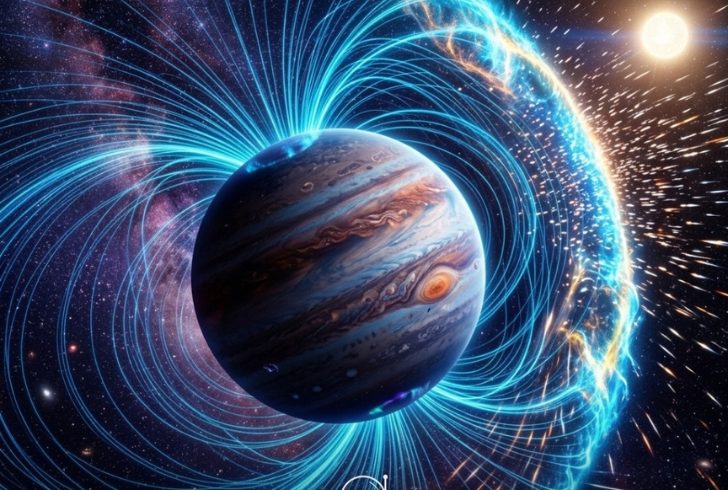
Instagram | spaceman.in | Atmospheric wind speeds offer an indirect way to measure exoplanet magnetic fields that slow circulation.
The findings still require confirmation through additional observations. Since the measurements rely on indirect evidence, astronomers want more data before drawing final conclusions.
Even so, the study marks an important step in exoplanet science.
“This breakthrough opens a completely new window on exoplanet research,” Julia Seidel said. “It’s the first time we can compare the magnetic environments of other worlds — a key step toward ultimately understanding which planets can stay alive, keep their water, and perhaps even, one day, host life as we know it.”
A New Way to Study Alien Worlds
The research highlights how exoplanet studies have changed over the past decade. Early discoveries focused mainly on finding individual planets and measuring basic features such as size and orbit.
Today, astronomers are identifying broader trends across multiple worlds, allowing them to compare planetary systems and better understand atmospheric physics under extreme conditions.
Astronomer Bibiana Prinoth, formerly of Lund University in Sweden and now with the European Southern Observatory, described the potential visual impact of magnetic interactions on distant planets.
“Here on Earth, we know the beauty of the northern and southern lights, where particles from the Sun hit our magnetic field and are guided toward the poles,” Prinoth explained. “I like to imagine that some of these worlds have a sky filled not only with stars, but with vast curtains of colorful light dancing across a planet that’s half in perpetual day and half in endless night.”
Recent observations of hot Jupiters have also challenged previous assumptions about planetary atmospheres. Researchers found that the hottest gas giants exhibit slower wind speeds than expected, with magnetic fields emerging as the leading explanation for this behavior.
If future studies confirm these findings, astronomers could gain a valuable new method for investigating magnetic activity and atmospheric dynamics on distant worlds exposed to intense stellar radiation.