Teleportation Exists—But Not the Way Sci-Fi Promised
The idea of vanishing from one place and instantly appearing somewhere else has fascinated people for decades. From classic science fiction to everyday daydreams, teleportation feels like the ultimate shortcut.
Still, real-world science tells a very different story—one that is far more subtle, complex, and grounded in physics than imagination suggests.
Recent headlines have added fuel to the conversation, blending bold personal claims with genuine scientific progress. The result is a topic that feels both mysterious and surprisingly real.
A Viral Claim That Sparked Debate
On April 3, 2026, a surprising statement stirred public curiosity. Greg Phillips, a senior official at the Federal Emergency Management Agency, claimed he had teleported to a Waffle House. According to The New York Times, employees and regular customers at the location did not recognize him from photos.
Phillips maintained that he experienced teleportation twice while living in Georgia. In one instance, he said he suddenly found himself inside the well-known 24/7 restaurant chain. At the time, he was undergoing intensive cancer treatment and taking strong medication.
He later clarified his wording on Truth Social, stating:
“The word ‘teleportation’ was not mine. It was used by someone else in the conversation reaching for language to describe something with no easy name.”
He added that terms like “translated” or “transported” might better describe the experience, referencing ideas familiar in religious contexts.
While the claim gained attention, it also highlighted how easily the concept of teleportation can blur between science, belief, and personal interpretation.
What Science Says About Teleportation
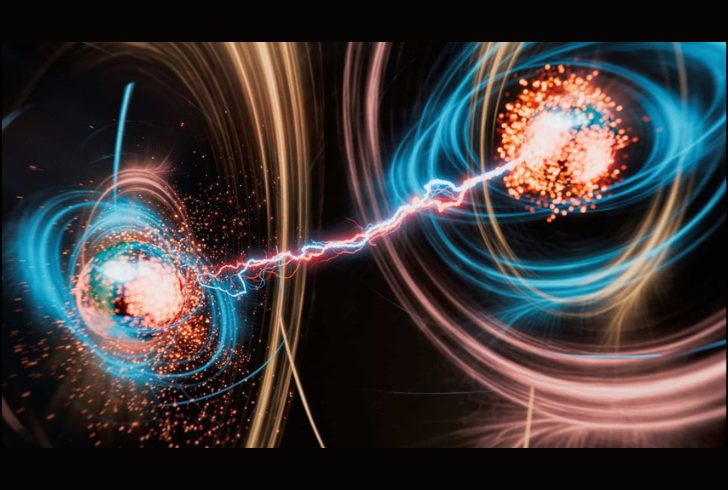
Freepik | sovereignty.ai | Quantum teleportation transfers a particle’s information to a new location without moving any physical matter.
Despite popular imagination, current scientific understanding does not support the idea of humans teleporting from one place to another. However, teleportation does exist in a limited and highly controlled form.
This process is known as quantum teleportation.
Rather than moving physical objects, quantum teleportation transfers information—the quantum state of a particle—from one location to another. The original particle does not travel. Instead, its exact properties get recreated elsewhere.
This process depends on a phenomenon called quantum entanglement. In simple terms, two particles become linked in such a way that changes to one instantly affect the other, no matter how far apart they are. Albert Einstein famously described this as “spooky action at a distance.”
Scientists use this connection as a bridge. By measuring one particle and applying that information to another, they effectively “teleport” its state.
Key Milestones in Quantum Teleportation
The idea first appeared in scientific literature in 1993. Since then, several experiments have pushed the limits of what is possible:
1. In 1997, physicists in Innsbruck, Austria successfully teleported the state of photons.
2. By 2002, researchers at the Australian National University transferred the quantum state of a laser beam.
3. In 2006, scientists at Denmark’s Niels Bohr Institute moved information from a laser beam into a group of atoms over a short distance.
4. In 2012, researchers in China achieved teleportation across more than 60 feet.
5. By 2017, Chinese satellites transmitted quantum information from space to Earth across hundreds of miles.
Progress has continued in recent years. In 2020, scientists suggested that electron teleportation might be achievable. Then, in 2025, researchers successfully transferred information between protons using light generated by quantum dots.
These breakthroughs matter because they support the development of ultra-secure communication systems and advanced quantum computing.
Why Human Teleportation Remains Out of Reach
Moving a single particle is one thing. Recreating an entire human being is an entirely different challenge.
A human body contains trillions of atoms. To teleport a person, every single one of those atoms would need to be mapped, transmitted, and reconstructed with absolute precision. Even the smallest error could result in severe consequences.
The energy required for such a process is beyond current technological capability. In fact, it may remain impractical for the foreseeable future.
There are also deeper concerns that go beyond physics.
If teleportation works by copying information and rebuilding it elsewhere, what happens to the original body? Does it get destroyed in the process? If so, is the person at the destination truly the same individual—or just an identical copy?
These questions touch on identity, consciousness, and what it means to exist.
Ethical and Physical Risks
The idea of human teleportation introduces serious risks that extend beyond technical challenges.
Even a minor error in particle placement could lead to irreversible damage. A misplaced atom might sound insignificant, but at a biological level, precision is everything.
There is also the possibility of intentional alteration. If a human body can be reconstructed, it could theoretically be modified. This raises concerns about engineered enhancements or unintended changes to memory and cognition.
Such scenarios shift teleportation from a transportation tool into something far more complex and potentially controversial.
Given these factors, traditional travel methods still appear far more reliable—and far less risky.
Teleportation in Religion and Culture
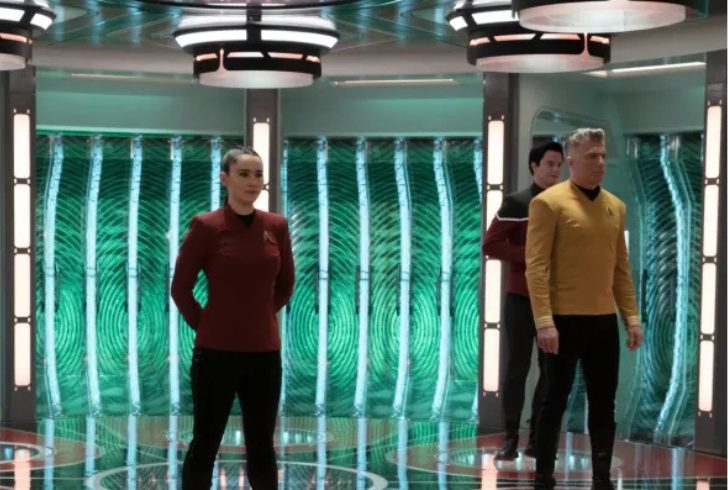
Facebook | Den of Geek | Popularized by “Star Trek,” the concept of teleportation is often linked to a quote that never existed.
Long before modern physics, the idea of instant movement appeared in spiritual and religious texts.
Ancient Indian writings, including the Vedas and Yoga Sutras, describe “siddhis”—abilities achieved through deep spiritual practice. These include accounts of sudden disappearance or movement across distances.
Similar themes appear in Jewish, Islamic, and Christian traditions. Certain biblical passages describe individuals being “transported” from one place to another in ways that resemble teleportation.
In modern culture, teleportation gained widespread recognition through science fiction. The concept became iconic in “Star Trek,” where characters used teleportation devices to travel between locations. Interestingly, the famous phrase “beam me up, Scotty” never appeared exactly as quoted in the series.
These portrayals shaped public expectations, even though real-world science operates on entirely different principles.
Everyday Explanations Still Matter
While teleportation captures imagination, many unusual experiences have more grounded explanations.
During interviews at the Waffle House mentioned in Greg Phillips’ claim, a land surveyor named Austin Spears offered a more down-to-earth perspective:
“I can say I’ve been drunk and ended up in a Waffle House. Don’t know how I got there. But I was there.”
His comment reflects a simple truth—unexpected situations do not always require extraordinary explanations.
Human memory, perception, and physical state can all influence how events are experienced and recalled.
Teleportation is real in a limited scientific sense, but it does not work the way movies portray it. Researchers have successfully transferred quantum information across distances, marking progress in communication technology.
However, moving an entire human body is still not possible due to extreme technical complexity, energy requirements, and unresolved ethical concerns. For now, teleportation remains confined to controlled lab experiments rather than everyday use.