
Often, being frustrated with the daily humdrum of urban life, we fantasize about leaving this planet and finding a new world (okay that’s a bit too dramatic we agree, but it’s fun imagining it all the same, isn’t it?).
Coming back to fantasizing about life outside of Mother Earth, regardless of wishing for it in our wildest of imaginations, we know there’s no sign of hope when it comes to existence beyond the Earth…or is there?
Well, if the scientists at NASA are to be believed, there just might be!
In February 2021 when NASA’s rover ‘Perseverance’ landed in Jezero crater on Mars, researchers could finally track down images of an ancient river on the red planet which suggests the existence of life there. Finally, a ray of hope in all their years of striving!
NASA’s perseverance through ‘Perseverance’
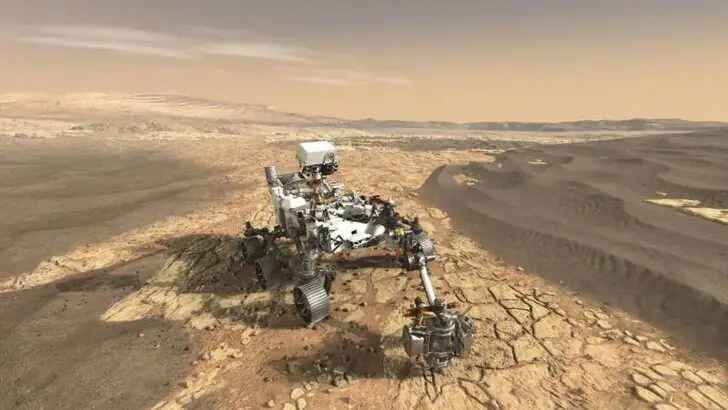
About the size of an SUV, ‘Perseverance’ has a two meter (seven foot) long robotic arm, two microphones, and a suite of other cutting-edge instruments. It took seven months for the rover to travel from Earth to Mars, and it was solely possible with the help of NASA’s Ingenuity Mars helicopter. During the course of this $2.7 billion mission, its two main tasks are:
- Hunt for signs of past Mars life
- Collect and cache dozens of samples for future return to Earth
To help it achieve this, Perseverance has been equipped with 19 cameras, one of which is called the SuperCam (it can laser-zap rocks that are at a distance to study their vapor to reveal their chemical composition). It also supports and documents the first few sorties of its traveling companion, Ingenuity, which is now flying more independently on the Red Planet.
The not-so-hollow Jezero crater
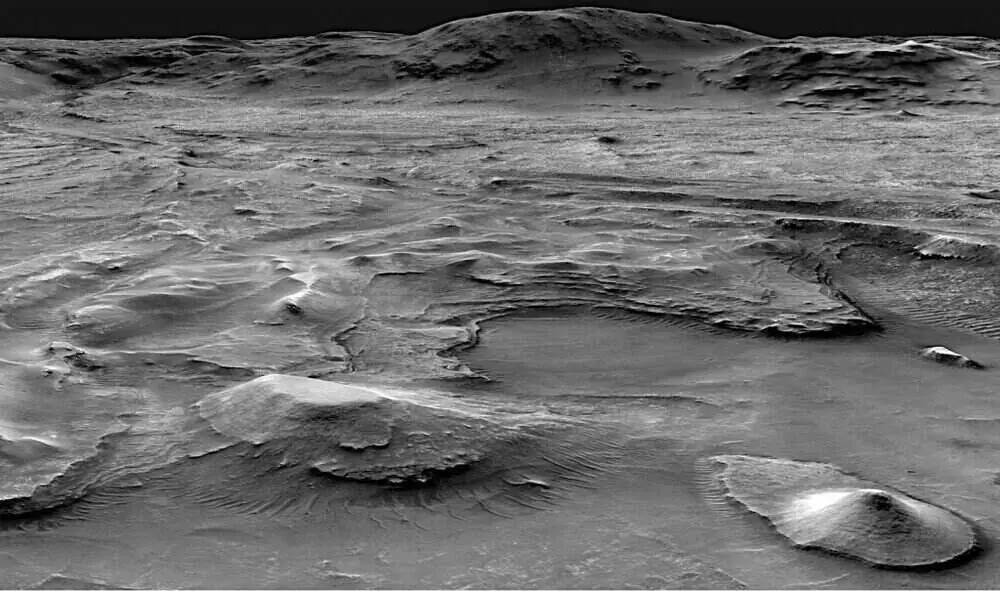
Sitting within the Isidis Planitia region of Mars, Jezero crater, which is bone-dry today like the rest of the Martian surface, houses a fan-shaped delta. But how did this delta develop there? From the high-resolution images captured by Perseverance, scientists suspect that this delta was formed by a long-gone river.
After analyzing the layers within the cliffs, NASA astrobiologist Amy Williams discovered similarities between the cliffs found on the crater floor with that of the patterns in Earth’s river deltas. The bottom three layers indicated the presence of a steady flow of water early on, while the top and the most recent layers present boulders which measure more than a meter in diameter and are believed to have been carried there because of violent flooding.
While these are significant findings on their own, it’s difficult for the researchers to decipher the entire probability just by seeing the orbital images of these cliffs. So, they intend to carry on a detailed analysis of the sediments. In this context, another scientist, Benjamin P.Weiss, states that it would be interesting to find out the time when this crater transitioned from an Earth-like habitable environment to this desolate landscape wasteland that we see now.
Hopefully soon, ‘Perseverance’ will have answers for all our queries!